Career Cluster Storytime: How to Use Storytelling To Teach Transferable Skills
Your Cliff Notes
- Career clusters are families of related jobs and industries.
- Transferable skills are abilities you can use in many settings, such as communication, teamwork, and problem-solving.
- Storytelling lets you model these skills in action. You do not need fancy props or a library of books.
- You need a simple framework: choose a relatable character, set up a challenge, and show how skills solve problems.
- Keep stories short, interactive, and tied to clusters so kids connect the dots between what they hear and what they can do.
We are in an era where information is available at our fingertips. And this is no longer restricted to adults. Kids have extremely easy access to information thanks to AI (e.g., chatbots in learning programs, ChatGPT, Siri, and Alexa, to name a few). This completely changes the scope of how students discover a career. Long gone are the days of going to the library to research your future career or “experiment” by picking a course elective in school. Because such information is readily available, educators must evolve as well. Rather than focus on teaching those career facts listed in textbooks, let’s focus our attention on teaching kids about the power of transferable skills. How do we do this? One approach is through storytelling.
Storytelling is more than entertainment; it’s a powerful teaching tool that makes career clusters and transferable skills come alive. Whether you are at the kitchen table or in a classroom circle, stories help learners imagine, connect, and practice the habits that lead to success. This blog will show you how to create and adapt stories so career education feels natural, fun, and skill-focused.
When Career Cluster Meets Storytelling
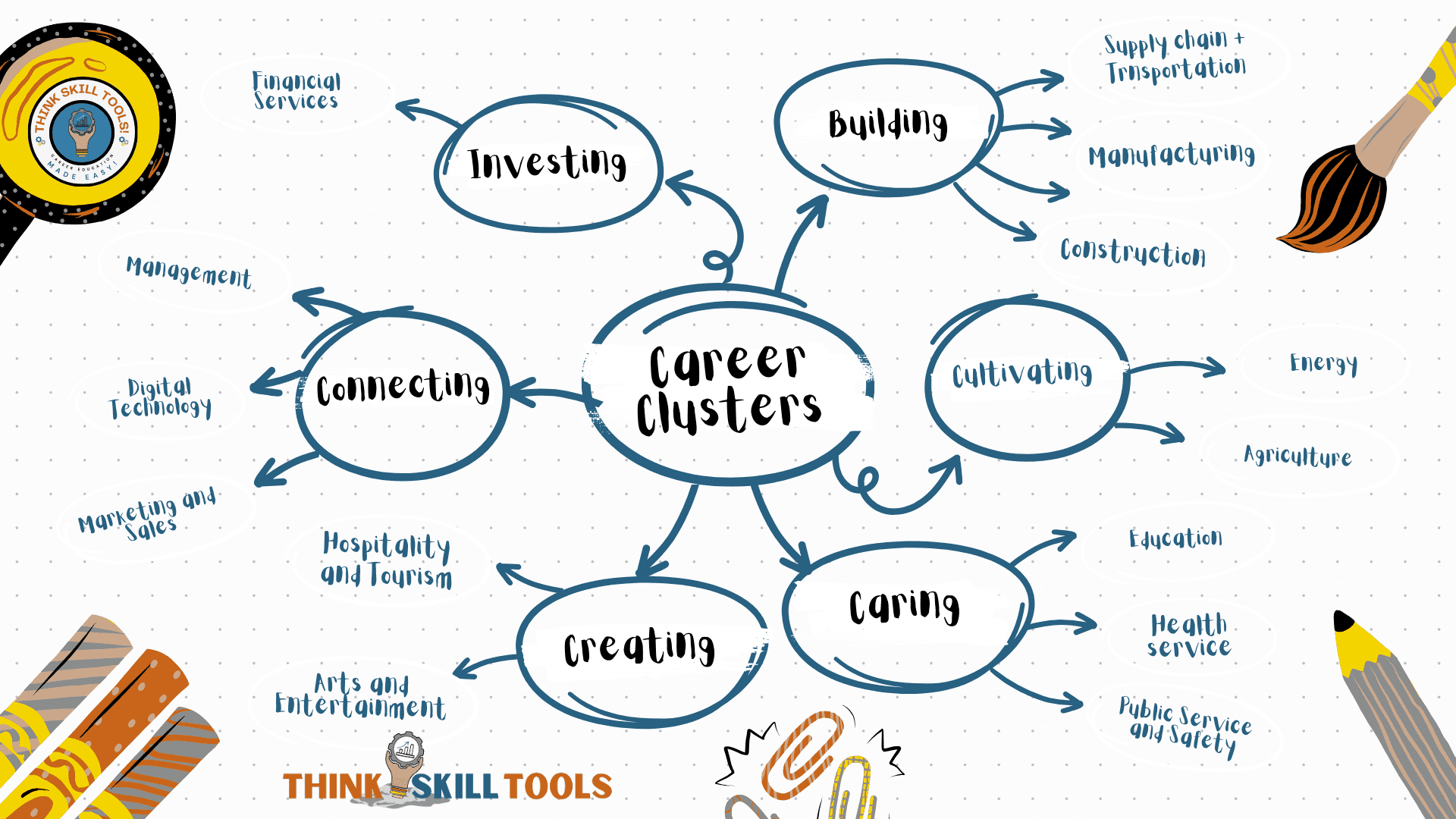
Career clusters are structured groupings of related occupations and industries that share common skills and knowledge areas. They serve as an organizing framework for career and technical education, helping learners connect academic content to real-world applications and future pathways. The modernized National Career Clusters Framework, stewarded by Advance CTE, currently includes 14 clusters and 72 sub-clusters, designed to bridge education and work by providing a shared language for program design and career readiness practices.
From a science of learning perspective, storytelling is a powerful pedagogical tool because it activates multiple cognitive processes—visualization, prediction, and emotional engagement—that enhance retention and comprehension. Research shows that storytelling improves attention, reduces anxiety, and strengthens skills like communication and problem-solving by embedding them in meaningful contexts. Stories create a narrative structure that mirrors real-world problem-solving, making abstract concepts tangible and memorable. Studies in educational psychology confirm that storytelling fosters deeper engagement and supports the development of transferable skills critical for success across career clusters.
How to use Storytelling To Teach Transferable Skills
If you have ever wondered how to make career education feel natural and engaging, storytelling is your secret weapon. Stories capture attention, spark imagination, and make abstract ideas concrete. When you weave career clusters and transferable skills into stories, you help learners see themselves as problem solvers, communicators, and team players in real-world contexts. This guide shows you how to build and adapt stories using familiar characters and everyday scenarios so that career learning happens without feeling forced.


Why Storytelling Works for Career Education
Storytelling works because it taps into how humans learn best—through narrative and emotion. When children hear a story, they visualize, predict, and empathize. These mental processes mirror the soft skills employers value: communication, adaptability, and collaboration. Stories create a safe space to explore choices and consequences without real-world risk. In career education, this means you can model decision-making, teamwork, and problem-solving in a way that feels like play.
It is well documented that narrative learning improves retention and engagement through many modes, like a student’s personal connection to the story as well as the level of “stickiness” (can learn more here). Stickiness refers to how well information is retained after you first learn something. When students listen to or create stories, they activate multiple parts of the brain, making the experience memorable.
- For younger learners, stories simplify complex ideas.
- For older learners, stories provide context for abstract concepts like leadership or adaptability.
By embedding career clusters into stories, you help students see how skills transfer across roles. For example, a story about a classroom team planning a science fair can highlight STEM clusters while modeling collaboration and time management.
Storytelling also supports equity in learning. Not every child has access to expensive career exploration tools, but every child can access a story. Whether you teach in a classroom, homeschool, or run a microschool, storytelling is a low-cost, high-impact strategy that works across settings.
How To Build a Story That Highlights Transferable Skills
Building a career-focused story does not require a degree in creative writing. Follow this simple structure:
- Step 1: Choose a relatable character. Pick someone familiar or create a fun persona like Captain Planner or The Teamwork Twins. Characters should feel approachable and age-appropriate. For younger learners, animals or toys can work well. For older learners, use peers or community helpers.
- Step 2: Set the scene. Place the character in a familiar setting—a classroom, kitchen, playground, or neighborhood. This helps students connect the story to their own experiences.
- Step 3: Introduce a challenge. The challenge should require more than one skill. For example, the Teamwork Twins need to organize a school fair with limited time and resources. They must communicate, delegate, and adapt when plans change.
- Step 4: Show the skills in action. Narrate how the character uses communication to share ideas, problem-solving to overcome obstacles, and teamwork to divide tasks. Use dialogue to make the skills explicit: “I’ll handle the posters while you set up the snack table.”
- Step 5: End with reflection. Ask, “Which skill helped the most and where else could we use it?” This turns the story into a mini case study for transferable skills.
For extra engagement, add cluster connections. If the story involves planning a menu, mention Hospitality and Tourism. If it includes building a booth, reference Architecture and Construction. These small touches help students link skills to clusters naturally.

Storytelling Activities That Teach Career Clusters
Once you have a story, turn it into an interactive experience. Here are practical ideas:
- Career Cluster Comic Strips: Students draw a short comic where characters solve a problem using cluster-related skills. For example, a comic about fixing a broken bike can highlight STEM and problem-solving. Younger learners can use stick figures and icons; older learners can add captions and dialogue.
- Role-Play Theater: Act out a story where each student plays a role tied to a cluster, such as chef, engineer, or safety officer. Give them props like aprons, rulers, or clipboards. After the role-play, debrief: “Which skill did you use and which cluster does it belong to?”
- Story Circle Challenges: Start a story and let each child add a sentence that includes a skill or tool. For example, “The chef grabbed a whisk to solve the problem.” This keeps everyone engaged and reinforces vocabulary.
Tips for Making Storytime Interactive and Skill-Focused
Ask open-ended questions during and after the story: ‘What would you do next?’ or ‘Which skill did the hero use?’ Use props or visuals like career cluster icons to anchor the language. Encourage students to remix the story by changing the setting or adding a new challenge. This builds creativity and deeper understanding. For younger learners, keep sessions under ten minutes and use lots of visuals. For older learners, add complexity by introducing constraints like time or budget.
Useful Tips According To Your Learning Space
- Home: Use family chores or routines as story settings.
- Classroom: Turn daily jobs into characters and plot points.
- Virtual: Use breakout rooms for story circles and digital whiteboards for comic strips.
Let’s Recap
- Storytelling makes career education engaging and skill-focused.
- When you build stories that highlight clusters and transferable skills, you help learners connect imagination to real-world possibilities.
- Start small, keep it interactive, and use the resources listed to deepen learning.

Hello There! Nice to meet you 🙂
I am Dr. Danielle Reid. Career education and keeping learning fun really is my jam. No, I am not a formally trained career coach. I am the product of a family that did some crazy-amazing career counseling to help me reach my dreams. Nowadays I find myself doing my own career counseling for my three kids, with a lot more knowledge, tools, and resources to share.