How to Teach Career Clusters Without a Curriculum

Your Cliff Notes
- Career clusters are families of related jobs that help kids see patterns in the world of work.
- You can point out clusters during everyday routines (cooking, cleaning, shopping, yardwork, errands).
- Use mini-activities: role-play, matching games, scavenger hunts, job-story cards, and reflection prompts.
- Keep it playful for K–5 with stories and visuals; scale up for grades 6–8 with simple data, budgeting, and planning tasks.
- Aim for 10–15 minutes, 3–4 times a week. Consistency beats intensity.
You do not need a stack of non-personalized career textbooks (or online career courses) to help kids explore careers. You need a curious mindset, a few minutes to prep with purpose, and a flexible learning space to help you curate this world of career exploration for students. This guide gives you a step-by-step way to turn everyday moments into powerful mini-lessons about career clusters. It’s hands-on, low-prep, and designed for parents, homeschoolers, and classroom teachers.
What Are Career Clusters and Why Do They Matter?
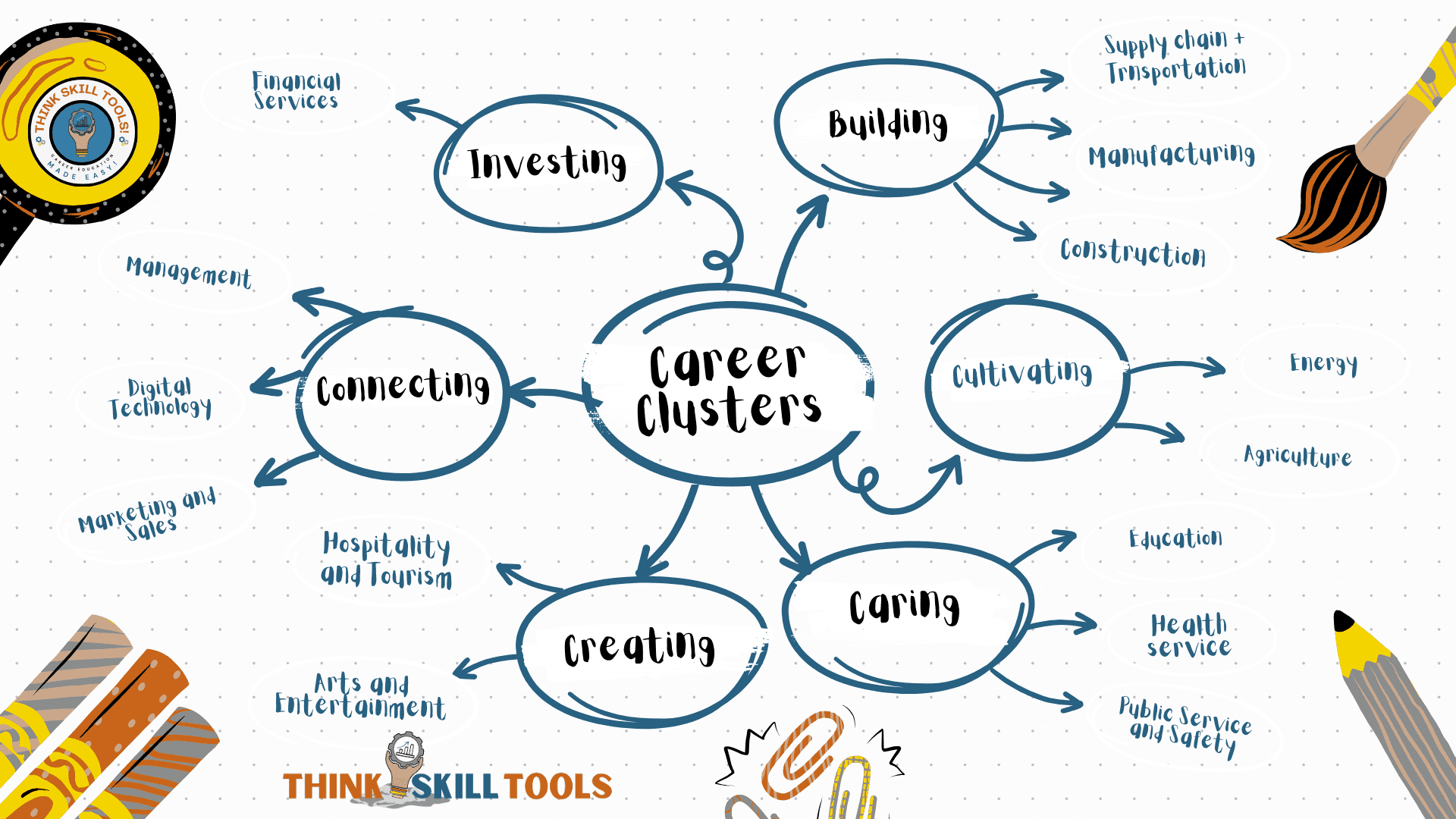
Career clusters are groups of related occupations that share similar skills, tools, and real-world contexts. Think of them like your map for career exploration. Instead of memorizing hundreds of job titles, you can help students explore 16 big “cities” of work (like Health Science, Information Technology, Agriculture, Food & Natural Resources, or Arts, A/V Technology & Communications).
For students, this grouping of jobs into career clusters helps eliminate the confusion that comes with career exploration. They also reduce overwhelm and build pattern recognition. As students explore, they start to notice, for example, that chefs, food scientists, and nutritionists all connect to how food is grown, prepared, and understood.
Pro tip: This connection doesn’t happen by chance in the workforce. Nutritionists can get a job as food scientists partly because of a powerful life tool called transferable skills. Think Skill Tools champions help students identify their transferable skills very early in life. You can learn more about how we are doing that through our virtual career center for students here: https://youtu.be/6CIgQeDD7X4?si=IvteQTVAppV70Kf8
Why Does This Matter?
Early exposure builds vocabulary, curiosity, and confidence. Students learn to connect schoolwork to purpose—fractions aren’t just numbers; they are recipes, budgets, measurements, and design constraints. Career clusters also help families talk about work without pressure. We are not asking an eight-year-old to choose a career; we are inviting them to notice how the world works and where they enjoy helping.
Keep Career Learning Fun Today!
Instant download our many digital products in our store shop.

How to Spot Career Clusters In Daily life
Every routine holds mini-lessons. Try narrating what you’re doing and ask, ‘Which cluster could this belong to?’ Here are everyday examples you can use right away:
- Cooking Dinner: Measure, time, heat, taste. Clusters: Hospitality & Tourism (culinary), Agriculture, Food & Natural Resources (food systems), Health Science (nutrition).
- Budgeting a Grocery Trip: Compare unit prices, calculate taxes, decide trade-offs. Clusters: Finance, Marketing (consumer decisions), Business Management & Administration.
- Gardening or Houseplants: Soil, sunlight, water cycles, pests. Clusters: Agriculture, Food & Natural Resources; STEM.
- Fixing a Leaky Sink: Tools, safety, troubleshooting. Clusters: Architecture & Construction; Manufacturing.
- Family Calendar & Chores: Scheduling, delegation, accountability. Clusters: Business Management & Administration; Education & Training (planning and routines).
- Neighborhood Walk: Map reading, traffic rules, community roles. Clusters: Law, Public Safety, Corrections & Security; Transportation, Distribution & Logistics; Government & Public Administration.
- Music or Theater Night: Performance, lighting, sound, promotion. Clusters: Arts, A/V Tech & Communications; Marketing.
- Pet Care: Health checks, feeding schedules, habitats. Clusters: Agriculture (animal systems); Health Science.


Simple Activities To Introduce Career Clusters At Home or School
Pick 1–2 activities per week and repeat them with new contexts so kids build fluency. Each activity below includes set-up, what to say, time needed, and how to scale by age.
Role-Play ‘Mini-Shift’
- Set-up: Pick a household task (like making pancakes) and assign roles—chef, food safety inspector, nutrition advisor, communications lead (menus), and marketer (name the dish).
- What to say: ‘Which cluster might each role fit? What skills do they use?’
- Time: 10–15 minutes.
- Scale: K–2 act it out with props; grades 3–5 add checklists; grades 6–8 add a 3-step improvement plan (time, cost, quality).
Matching Game: Job–Tool–Place
- Set-up: Write cards for JOB (chef, paramedic, app designer, landscaper), TOOL (thermometer, stretcher, tablet, pruning shears), and PLACE (kitchen, ambulance, makerspace, garden).
- What to say: ‘Match a job to a tool and a place—then name the cluster.’
- Time: 10 minutes.
- Scale: K–2 match pictures; grades 3–5 add verbs (measure, design, repair); grades 6–8 justify matches with 1–2 sentences.
Scavenger Hunt: Find the Cluster
- Set-up: Make a 6-item list (something that measures, something that protects, something that connects people, something that grows, something that moves, something that entertains).
- What to say: ‘Find items and tell which cluster they relate to and why.’
- Time: 15 minutes.
- Scale: K–2 draw what they found; grades 3–5 label with cluster names; grades 6–8 sort by primary vs. secondary cluster.
Kitchen Lab: Fractions to Functions
- Set-up: Double or halve a simple recipe. Track time and steps.
- What to say: ‘Where do we see math, safety, quality control, and communication?’
- Time: 20–30 minutes (or across two days).
- Scale: K–2 measure with scoops; grades 3–5 use timers and temperature logs; grades 6–8 compute cost-per-serving and a short product review.
Neighborhood Systems Map
- Set-up: Sketch a simple map. Mark places like the library, clinic, grocery, post office, park, bus stop.
- What to say: ‘Which clusters keep each place running? What jobs work together?’
- Time: 20 minutes.
- Scale: K–2 use stickers; grades 3–5 draw arrows for services; grades 6–8 add a ‘what-if’ scenario (power outage, big event) and plan roles.
Career Story Cards
- Set-up: Make index cards with prompts like ‘I help things grow,’ ‘I keep people safe,’ ‘I tell stories with pictures,’ ‘I fix what’s broken.’
- What to say: Learners choose a card, act it out, or describe a day on the job; others guess the cluster.
- Time: 10 minutes.
- Scale: K–2 charades; grades 3–5 add tools; grades 6–8 add education pathways (certificate, apprenticeship, degree).
Budget the Party
- Set-up: Plan a simple party for four guests with a $20 budget. List needs (food, decorations, music), compare prices, and track choices.
- What to say: ‘Which clusters show up when we plan, budget, and promote an event?’
- Time: 25 minutes.
- Scale: K–2 pick between two prices; grades 3–5 use unit prices; grades 6–8 create a mini-spreadsheet and reflection on trade-offs.

Tips for Keeping It Fun and Age-Appropriate
The goal is joyful awareness, not job selection. Keep the tone exploratory and positive.
- Start with stories: Tell a quick ‘day-in-the-life’ narrative before the task. Stories build empathy and context.
- Use visuals: Icon cards, doodles, and color-coding help younger learners sort clusters fast.
- Make it tactile: Turn chores into missions with badges or stickers. Hands-on = buy-in.
- Invite choice: Offer two roles or two tools to pick from—choice increases motivation.
- Celebrate attempts: Praise curiosity and effort (‘Great inference!’) more than correctness.
- Name transfer skills: Point out communication, problem-solving, and teamwork across clusters.
- Keep sessions short: 10–15 focused minutes beats an hour of dragging feet.
- Reflect and rotate: Ask one question at the end: ‘Where else could we use this skill?’ Then try a new context tomorrow.
Mini-Scripts You Can Use
- We are planning dinner. Which cluster does measuring and timing belong to? Who checks safety?’
- Look at this toolbox—what jobs might use these tools? Which clusters?’
- ‘The library is closed today. Which clusters work behind the scenes to keep it running on other days?’
- ‘We have $15 for snacks. What’s our plan? Which clusters help us budget and compare?’
Lightweight Assessment (Without Grades)
Keep track of growth with a simple learning log. Once a week, ask learners to complete two prompts: 1) ‘This week I noticed these clusters…’ 2) ‘One skill I used in more than one cluster was…’ Optionally add a photo of their activity or a quick voice note. Over time you’ll see vocabulary grow, connections deepen, and confidence climb.
Troubleshooting Common Roadblocks
- My learner isn’t interested.’ Offer choice and start with their world (pets, sports, music, games). Keep it under 10 minutes and end on a win.
- ‘We don’t have supplies.’ Use what’s around you: paper scraps, pantry items, recycled boxes, sidewalk chalk.
- ‘I’m not sure I’m doing it right.’ You are! The point is noticing and naming—there’s no perfect script.
- ‘We’re short on time.’ Attach the career cluster your student is exploring to something you are already doing (dinner prep, dishwashing, commute).
Let’s Recap
- Career clusters simplify the world of work into patterns kids can see.
- Daily routines are rich with authentic examples—keep naming and connecting.
- Short, repeatable activities build vocabulary, confidence, and transfer skills.
- Make it playful, visual, and choice-driven—especially for younger learners.

Hello There! Nice to meet you 🙂
I am Dr. Danielle Reid. Career education and keeping learning fun really is my jam. No, I am not a formally trained career coach. I am the product of a family that did some crazy-amazing career counseling to help me reach my dreams. Nowadays I find myself doing my own career counseling for my three kids, with a lot more knowledge, tools, and resources to share.