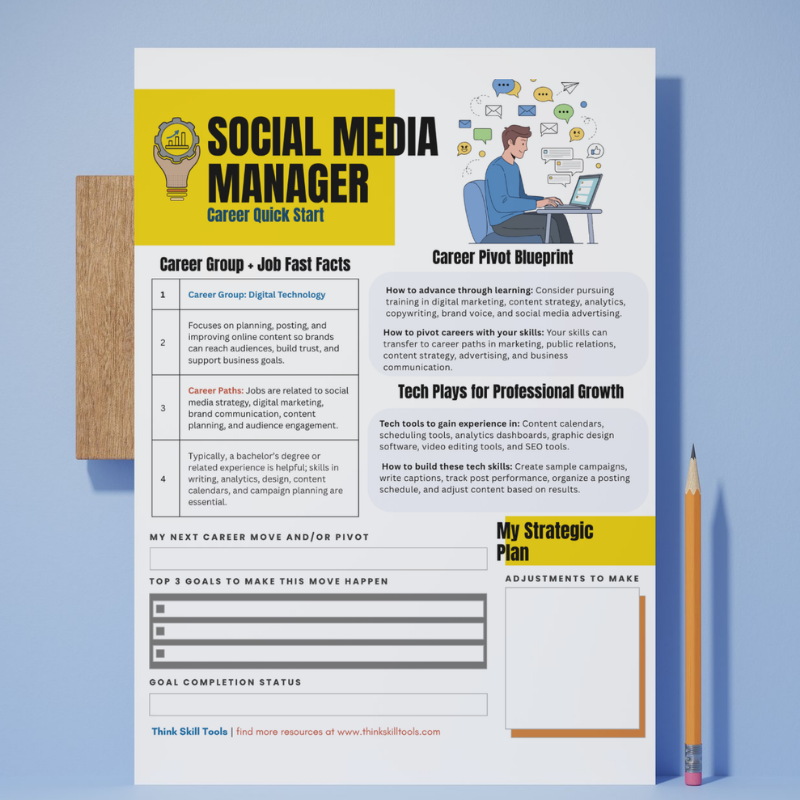
Career Cluster Station Ideas for K–8 Students

Your Cliff Notes
- Career Cluster Stations help students explore tools, tasks, and vocabulary across different career fields in age-appropriate, hands-on ways.
- Stations work best when they are simple, tactile, and built around one clear tool, one skill, and one quality check.
- Each cluster gives students a chance to practice real-life behaviors like planning, sequencing, communication, and observation.
- Stations scale effortlessly across grade bands by adjusting complexity rather than changing the core task.
- Mixing clusters exposes students to pathways they may never have considered, making career learning more inclusive and curiosity-driven.
Before diving into these station ideas, be sure to read the companion blog “What Is a Career Cluster Day?” so you understand the purpose, flow, and structure behind this transformative learning experience. Yes, these station ideas offer K–8 learners a meaningful way to explore careers through short, hands-on activities that feel fun, accessible, and connected to real life. Instead of only talking about jobs, students use tools, test ideas, and practice skills that professionals use every day.
Now if you want to turn that initial curiosity into a more structured learning experience, browse our Curriculum Collection to compare complete curriculum bundles, individual career courses, and independent Career Kits. This gives you the flexibility to choose a resource based on your learners, schedule, and preferred level of instructional support.

Station Ideas For Various Career Clusters
Career stations can also help you decide which career topics deserve a deeper lesson. Pay attention to the stations that generate the most questions, discussion, and participation. That interest may show you which occupation or career cluster to explore next.
If your students are interested in healthcare and science, the Health Sciences and Care Pathways curriculum bundle can help you build a larger career-learning experience without piecing together every lesson yourself. The bundle is listed within the Curriculum Collection alongside individual career courses, allowing you to choose between a broader pathway experience and a focused lesson
The station ideas provided in this blog are intended as a primer. Use them to support your career lesson or add them as a project hands-on learning opportunity in your career-based curriculum. Each example gives you a starting point for planning, but you will need to expand the instructions, adapt tasks for your learners, and ensure safety and age-appropriateness. Feel free to add more detail, integrate local resources, and customize the activities to fit your space, time, and student needs.
Health Station
- Station Idea: Set out a digital thermometer, gloves, and a sink or sanitizer. Demonstrate the proper way to take a temperature on a prop or show how to read the display. Invite students to practice a handwashing routine with a 20-second timer.
- Primer Prompt: Say, “This is the health world. Our tool is a thermometer, and our safety step is gloves. Our quality check is a clear reading and clean hands.”
- Grade Band Adaptations: For K through 2, role-play taking a teddy bear’s temperature. For 3 through 5, record mock readings and compare. For 6 through 8, add a short scenario where they decide when to retake a reading or refer to a nurse.
The Health Station offers a quick introduction, but your students may be ready to investigate a specific healthcare occupation. The Nurse Practitioner Career Exploration Course transforms that interest into a guided lesson with discussion, a clinic simulation, learner activities, and a career portfolio project. You can teach it as a single 45- to 50-minute experience or use the included supports to expand the learning over several days.
STEM Station: Measure, Plan, and Test
- Station Idea: Provide tape measures, rulers, paper, and paper clips. Challenge students to design a paper bridge that can hold a small stack of clips.
- Primer Prompt: Say, “This is the design world. Our tool is a ruler. Our safety step is to clear the workspace. Our quality check is whether the bridge holds the weight.”
- Grade Band Adaptations: For K through 2, fold one simple bridge and test. For 3 through 5, compare two designs. For 6 through 8, add a limit on materials and a short written improvement note.
A simple design challenge can open the door to careers that rely on testing, observation, troubleshooting, and improvement. If your students are particularly interested in solving technology problems, the IT Technician Career Exploration Course gives you a ready-to-use way to continue the learning. Students investigate technical issues, test solutions, document findings, and practice systematic problem-solving through a hands-on troubleshooting challenge.
Agriculture Station: Soil and Seed Basics
- Station Idea: Set out small cups, soil, and a few seeds or beans. Show how to fill a cup, press a seed, and label the container.
- Primer Prompt: Say, “This is the agriculture world. Our tool is a scoop. Our safety step is to keep soil off the floor. Our quality check is a labeled cup and proper depth.”
- Grade Band Adaptation: For K through 2, focus on scooping and labeling. For 3 through 5, compare light and shade placement. For 6 through 8, record a prediction chart for germination.
Hospitality Station: Menu and Measurement
- Station Idea: Place measuring cups, a whisk, a bowl, and a sample recipe. Invite students to measure dry ingredients for a pretend pancake mix and time a one minute whisk.
- Primer Prompt: Say, “This is the hospitality world. Our tool is a measuring cup. Our safety step is clean hands. Our quality check is a level scoop and clear labeling.”
- Grade Band Adapations: For K through 2, practice leveling flour with a flat edge. For 3 through 5, double or halve a recipe. For 6 through 8, compute cost per serving from a small price list.
Public Safety Station: Safety Scan
- Station Idea: Create a pretend room scene on a table with mini items or photos. Hide three hazards, such as a cord across a walkway, an open container, or a blocked exit.
- Primer Prompt: Say, “This is the public safety world. Our tool is our checklist. Our safety step is to scan before we act. Our quality check is whether we spot all hazards.”
- Grade Band Adaptations: For K through 2, circle hazards on a picture. For 3 through 5, sort hazards by type. For 6 through 8, propose a fix with a short reason.
Some of the most interesting careers are the ones students rarely see. The Health Unit Coordinator Career Exploration Course introduces students to the communication, scheduling, organization, and attention to detail that help a hospital unit operate effectively. It is a helpful next step when you want students to explore an important healthcare role that works behind the scenes.
Arts and Communications Station: Poster Sprint
- Station Idea: Provide markers and a quarter-sheet poster template with a title box, an image box, and a three-word message line. Challenge students to design a quick safety or event poster.
- Primer Prompt: Say, “This is the arts and communications world. Our tool is a storyboard. Our safety step is a clean workspace. Our quality check is a clear message that people can read in five seconds.” Grade Band Adapations: For K through 2, trace a title and draw a simple icon. For 3 through 5, add a tagline. For 6 through 8, add a call to action and think about the audience.
Information Technology Station: File and Folder Hygiene
- Station Idea: Give students a short list of messy file names on paper and ask them to rename them using a simple convention like (date, topic, and version).
- Primer Prompt: Say, “This is the technology world. Our tool is a naming rule. Our safety step is privacy rules. Our quality check is whether you can find the file in ten seconds.”
- Grade Adapations: For K through 2, sort picture cards into two folders. For 3 through 5, practice one naming rule. For 6 through 8, create a mini help guide for classmates.
Construction Station: Level and Line
- Station Idea: Place a level, painter’s tape, and a simple sketch. Invite students to tape a straight line on the floor, then check the level on a taped square on a table.
- Primer Prompt: Say, “This is the construction world. Our tool is a level. Our safety step is watch your fingers. Our quality check is a bubble in the middle.”
- Grade Adaptations: For K through 2, follow a taped path. For 3 through 5, measure and mark before taping. For 6 through 8, draw a basic plan with measurements.
Education and Training Station: Micro Lesson
- Station Idea: Ask students to pick a simple skill they learned today and teach it to a partner in one minute. Provide a mini lesson plan card with open, show, try, and close.
- Primer Prompt: Say, “This is the education world. Our tool is a plan. Our safety step is respectful talk. Our quality check is whether your partner can do the step.”
- Grade Adapations: For K through 2, teach a simple clap pattern. For 3 through 5, teach a fold or tie. For 6 through 8, teach a two-step process and ask for feedback.
With these stations, aim for a mix of career clusters so students can experience a variety of tools, tasks, and workplace skills. You do not need to cover every cluster in one event. Rotate new stations throughout the year and let learners help choose or design future activities.
When one station sparks strong interest, you can extend it with an individual career course instead of designing a full lesson yourself. For example, the Laboratory Technician Career Exploration Course uses guided discussion, career-connected activities, companion pages, and a hands-on investigation to help learners examine a health science occupation in greater depth.


Follow-Up Activities to Keep the Learning Going
Your career station idea should not end when the timer stops or when class ends. The effectiveness of such career exploration opportunities is truly impactful when you add short follow-ups that build memory and ownership. Start with a reflection journal. Ask three questions: What did I try? Which tool did I use? Which skill helped me succeed? Younger learners can draw a picture and label one word. Older learners can write two to three sentences and note where they might use that skill again this week. Here are some other ideas to keep the learning going:
- Create a cluster map on a wall or in a notebook. Add the stations you offered and list a few job titles that connect. Invite students to link skills across clusters with yarn or lines. For example, when a student notices that quality checks show up in Hospitality, Health, and Construction, they begin to see how skills transfer across the world of work. That insight is the heart of career readiness at the K through 8 level.
- Schedule a mini project a few days later that reuses a station skill. If you had a STEM bridge station, launch a simple improvement challenge with a time limit. If you had an Arts poster station, ask students to refine their poster using one feedback note from a partner. If you had a Hospitality measure station, let students design a snack kit for four with a budget of five dollars. Repetition builds mastery and confidence.
- Capture growth with a short learner portfolio. Save one reflection, one photo, and one artifact per station you run (in your learning space) over the course of a school year. Over time, you will have a record of skills practiced, clusters explored, and language gained. This portfolio is a powerful conversation starter with families and administrators. It is also a confidence booster for students who can see progress over time.
- Finally, make the next career station idea easier by debriefing solo or with other teachers/parents. Think of one thing that went well and one idea to streamline. Update your station briefs and your rotation map.
Not every station needs to become a full class lesson. If you have learners ages 12 and older who are ready to continue independently, Career Kit Workbooks provide a no-prep alternative. Learners can work through real-world job stories, workplace thinking activities, career facts, life-skill connections, and reflection without requiring you to teach a complete course.
Let’s Recap
- Career Cluster Stations help students make meaningful connections between tools, tasks, and real-world careers.
- A simple structure (one tool, one safety step, one quality check) keeps stations smooth and age-appropriate.
- Stations scale easily across grade levels and build confidence through exploration and repetition.
- Follow-up activities deepen learning and strengthen vocabulary, skill transfer, and memory.
- Over time, students begin to naturally identify clusters, name skills, and reflect on how work gets done.
- Explore the Curriculum Collection to find complete curriculum bundles and individual career courses with guided instruction and hands-on workplace simulations.
- Try the Career Kit Workbooks when you need no-prep, independent career exploration for learners ages 12 and older.
- Browse the Career Activity Sheets for flexible career discovery, exploration, planning, and reflection activities that fit into shorter learning blocks.

Hello There! Nice to meet you 🙂
I am Dr. Danielle Reid. Career education and keeping learning fun really is my jam. No, I am not a formally trained career coach. I am the product of a family that did some crazy-amazing career counseling to help me reach my dreams. Nowadays I find myself doing my own career counseling for my three kids, with a lot more knowledge, tools, and resources to share.