Transformative Education: Finding Our Way to a Solution That Sticks
Updated September 2026
Note from Dr. Danielle Reid: Transforming a learning space in a way that meaningfully improves how learners think, participate, and apply knowledge is not easy. Also, lasting transformation does not come from adding another tool to your learning space. True transformation comes from creating purposeful learning experiences that help students connect ideas, practice skills, and recognize why their learning matters.

Your Cliff Notes
- Transformative education helps learners move beyond memorizing information and begin questioning, applying, reflecting, and making meaningful connections.
- Active learning, storytelling, project-based learning, career exploration, collaboration, and real-world problem-solving can make learning more relevant.
- Educational transformation does not require replacing every lesson, purchasing complicated technology, or redesigning the entire learning environment at once.
- A small instructional change can become transformative when it gives learners more ownership, purpose, application, and opportunities to reflect.
- Teachers and parents should evaluate a learning solution by how well it supports the learner, not by how new or impressive the solution appears.
- Think Skill Tools and Science L.E.A.F create practical learning resources that connect academic ideas to transferable skills, career exploration, and real-life application.
Transformative education really is this powerful concept that reaches into the heart of learning. It is not just about memorizing facts or passing tests. It is about helping learners grow, think critically, ask thoughtful questions, recognize different perspectives, and use what they learn beyond the assignment.
Transformative education encourages us to look beyond the surface and reconsider what meaningful learning can look like. It recognizes that education is not restricted to what happens inside a classroom. Learning also happens at home, in the community, during projects, through conversations, and while solving everyday problems.
In this article, we will examine what transformative education can look like, practical ways to support it, and how to choose learning solutions that are meaningful, flexible, and sustainable.
For a deeper look at the philosophy behind this approach, take a look at this great read from Science L.E.A.F (our parent company). The article is part of the Science L.E.A.F, collection of content examining learning, motivation, project-based instruction, memory, career exploration, and learning environments.

What Should Transformative Education Look Like?
The phrase transformative education can sound complicated. It may even seem too broad or dynamic to use in an everyday learning environment. The reality is that transformative education does not have to begin with a complete instructional overhaul. It can begin when we make one thoughtful change that helps learners participate more actively, understand an idea more deeply, or apply knowledge in a meaningful way. In a transformative learning environment:
- Learning spaces become places for exploration, collaboration, and meaningful dialogue.
- Learners are encouraged to ask questions and investigate complex issues.
- Lessons strengthen critical thinking, creativity, communication, empathy, adaptability, and resilience.
- Learners have opportunities to make decisions and take ownership of part of the learning process.
- Different backgrounds, perspectives, experiences, and learning environments are respected.
- Activities connect academic knowledge to real-life challenges and future possibilities.
- Reflection helps learners explain what they did, what they learned, and what they may do differently next time.
- Quality is measured through understanding and application, not only task completion.
Transformative education should inspire curiosity, strengthen purpose, and equip learners with technical and transferable skills they can use as their responsibilities grow. The environment itself can also influence the learning experience. Science L.E.A.F discusses this relationship in this great read about cultivating enriching physical spaces for our learners to truly fall in love with learning.

Transformation Begins With the Learner
A solution is not transformative simply because it is new, digital, colorful, or different from what was used before.
The solution must improve the learning experience.
Before introducing a new strategy, activity, platform, or resource, consider asking yourself:
- What should learners understand or be able to do?
- Why does this learning matter?
- How will learners participate?
- Where will learners make decisions?
- How will the lesson connect to real life?
- Which transferable skills will learners practice?
- How will learners show what they understand?
- What opportunities will learners have to reflect?
- Can the experience be adapted for different learning needs?
- Is the solution sustainable in this learning environment?
At Think Skill Tools, we use this same learner-centered approach when connecting everyday experiences to career discovery. For example, How to Teach Career Clusters Without a Curriculum shows how cooking, budgeting, gardening, household repairs, neighborhood observations, and other routines can become meaningful career-learning opportunities.

Practical Approaches to Transformative Education
There is no single method that will transform every lesson or work equally well for every learner. A better approach is to choose a strategy that supports the learning goal, fits the environment, and gives learners a purposeful role.
Project-Based Learning
Project-based learning gives learners an opportunity to investigate a question, address a challenge, create something meaningful, and explain their decisions. A strong project is not merely a large craft or a collection of disconnected tasks. It should require learners to use knowledge and skills purposefully. A project may ask learners to:
- Investigate a community need
- Design a possible solution
- Compare different approaches
- Plan a budget
- Build and test a model
- Create a public-awareness message
- Organize an event
- Present findings to a specific audience
- Reflect on the strengths and limitations of the final result
If you want to learn more, check out this article, which provides a closer look at this approach.
Experiential Learning
Experiential learning gives learners an opportunity to practice, observe, test, or perform a task connected to an actual context. This might include:
- Conducting an investigation
- Completing a workplace simulation
- Interviewing a professional
- Participating in a role-play
- Teaching a skill to someone else
- Planning a small event
- Creating a digital or physical product
- Completing a service project
- Testing a process and improving it
The experience becomes more meaningful when learners reflect on what happened. Want to test drive this technique? Start with our Career Cluster Station Ideas for K–8 Students article, which hands-on station ideas built around workplace tools, tasks, safety practices, and quality checks.
Storytelling
Now this is by far our favorite technique! Stories make abstract ideas easier to connect to people, decisions, consequences, and real situations. A story can introduce:
- A professional solving a workplace problem
- A learner overcoming a challenge
- A community responding to a need
- A team working toward a shared goal
- A person discovering an unexpected career
- A decision with several possible outcomes
After reading or listening to the story, learners can identify the challenge, analyze the response, suggest another solution, and connect the experience to their own lives. If you want to take a deeper dive into the art of storytelling, read this article to continue exploring the role of stories in meaningful learning.
Skill Sharing
At Think Skill Tools, we took this concept and developed a fresh new approach when it comes to career learning. Skill sharing begins with a simple question: What can you teach someone else?
A learner might demonstrate how to create a graphic, care for a plant, organize a digital file, prepare a recipe, solve a puzzle, use a budgeting tool, or complete a household task. Teaching the skill requires more than completing the task. The learner must plan, sequence information, communicate clearly, respond to questions, and determine whether the other person understands.
We definitely encourage you to check out our Skill Sharing: Why It Matters More Than You Think article. At Think Skill Tools, we embrace using everyday abilities as entry points into career discovery, transferable skill recognition, and meaningful peer learning.
Once you have a full grasp of this epic mashup of skill sharing x career learning, check out this article, which shows you how to turn the idea into a complete activity with How to Host a Skill-Sharing Project.
Career-Connected Learning
Career-connected learning helps students understand where knowledge and skills may be used beyond the classroom. It does not require asking every learner to select one permanent career. Instead, it encourages learners to:
- Notice how professionals solve problems
- Identify the skills used in different fields
- Investigate workplace tools and environments
- Connect academic subjects to occupational tasks
- Practice decision-making through workplace scenarios
- Reflect on their interests, values, and developing abilities
- Build a Career Portfolio containing meaningful work samples and evidence of growth
This technique really can begin with one small activity. Want to see how this actually happens? Our Career Cluster Match-Ups: Turn Chores Into Career Lessons article is a great resource! It demonstrates how everyday responsibilities can become small learning laboratories involving tools, time, quality, planning, safety, and problem-solving. This article is also a great resource to keep the learning going regarding this technique.

Turn Transformative Ideas Into Ready-to-Use Learning
A strong idea is only the beginning. Teachers and parents still need suitable materials, clear instructions, learner activities, and meaningful ways to extend the experience. Without that structure, even an exciting project can become another disconnected activity instead of a learning experience learners can apply, reflect on, and remember. At Think Skill Tools, we provide several levels of support so you can choose the amount of structure that fits your learners, schedule, and learning environment:
- Career Activity Sheets provide short, focused activities for career discovery, exploration, planning, reflection, and readiness.
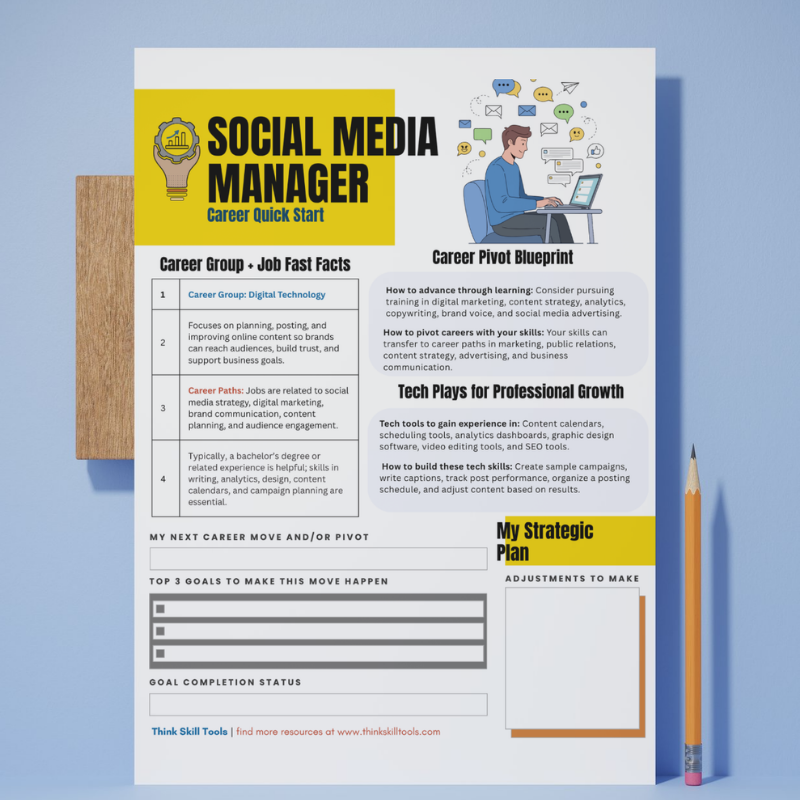
- Career Quick Start Guides provide concise career facts, skill connections, and practical planning support.
- Career Kits provide independent, open-and-go career exploration for learners ages 12 and older.
- Teacher Resources provide additional instructional support.
- The Curriculum Collection provides educator-led career courses with instructor guidance, learner materials, digital presentations, workplace simulations, reflection, and Career Portfolio development.
These resources help you move from introducing an idea to giving learners a structured opportunity to use it. You can begin with one activity, continue with independent exploration, or teach a complete career lesson without creating every component from scratch.
Stop Building Every Learning Experience From Scratch
Choose ready-to-use career resources that help learners apply knowledge, practice transferable skills, and connect learning to real-world possibilities.

Making Transformative Education Work in Any Learning Environment
Transformative education can happen in a traditional classroom, homeschool, microschool, co-op, community program, or independent learning space. The setting may change, but the central goal remains the same: learners need meaningful opportunities to question ideas, apply knowledge, solve problems, create useful work, and reflect on what they experienced.
The strategy does not need to look identical in every environment. A classroom teacher may add a workplace scenario to an existing lesson, while a homeschool parent may turn meal planning, gardening, or budgeting into a practical project. What matters is whether the experience helps learners understand why the lesson is useful and how the knowledge or skills can be applied again.
Ok let’s get this disclaimer out here: A new strategy is not automatically transformative because you toss in some app, digital interactive, or random hands-on activity into your lesson planning. Transformation is all about being intentional. The strategy must support a clear learning goal.
Adapt the Experience to the Learning Environment:
- In a traditional classroom, transformative learning might include a realistic problem, collaborative roles, a quality check, or a connection to a career. A science lesson about measurement could include a workplace quality-control challenge. A writing lesson could ask learners to create a message for a particular audience, and a mathematics lesson might include budgeting or resource allocation.
- At home, everyday responsibilities can create equally meaningful experiences. Meal planning can introduce budgeting, nutrition, measurement, and time management. Gardening can introduce plant biology, observation, environmental science, and long-term planning. Organizing a room can strengthen categorization, workflow design, and quality control.
- Independent learning can also be transformative when learners do more than read information and answer recall questions. A strong independent activity asks learners to compare possibilities, make decisions, explain their reasoning, create something useful, and reflect on how their thinking developed.
Give the Learning Somewhere to Go Next:
Always keep in mind, transformative learning is not a one time thing. It should not end when the activity is finished. A strong experience creates another question, a new interest, or an opportunity to explore more deeply. A learner who enjoys a healthcare simulation may be ready to investigate a specific occupation. Someone who enjoys planning a budget may want to explore finance, hospitality, business operations, or project management. A learner who enjoys troubleshooting technology may be ready for a more focused information-technology lesson.
Let’s Recap
- Transformative education helps learners question ideas, apply knowledge, practice useful skills, and connect learning to real life.
- Discover how the physical environment can support learning in this article about creating enriching learning spaces.
- Strengthen learner ownership by weaving in purposeful real-world challenges to your lesson planning.
- Turn everyday skills into career-learning experiences with Skill Sharing: Why It Matters More Than You Think and other practical Think Skill Tools activities.
- Move from a strong idea to structured implementation with the Think Skill Tools Curriculum Collection, featuring educator-led courses, workplace simulations, learner materials, and Career Portfolio activities.

Hello There! Nice to meet you 🙂
I am Dr. Danielle Reid. Career education and keeping learning fun really is my jam. No, I am not a formally trained career coach. I am the product of a family that did some crazy-amazing career coaching to help me reach my dreams. Nowadays I find myself doing my own career coaching for my three kids, with a lot more knowledge, tools, and resources to share.