How to Upgrade Your Resume Skills at 30ish to Break Out of a Mid-Career Rut

Your Cliff Notes
- A mid-career pivot requires a different resume strategy: Employers may need to see more than basic dependability and teamwork. They may also look for evidence of judgment, leadership, process improvement, and responsibility.
- Leadership does not always require a management title: Training coworkers, handling difficult situations, improving a workflow, and becoming the person others trust can all provide leadership examples.
- Operational duties need context: A resume becomes stronger when it explains what you improved, protected, organized, solved, or helped move forward.
- A two-page resume can be appropriate: Experienced professionals may need a second page when their relevant accomplishments, credentials, projects, and technical skills cannot be presented clearly on one page.
- A career pivot needs a connecting story: Your resume should help employers understand how your previous experience prepares you to contribute in a different industry.
This is many, many people’s story right now. Even at Think Skill Tools it was the story for many of us as well! You open the resume you have been updating since your early 20s and immediately notice a pattern. Every job includes another list of duties: assisted customers, maintained equipment, completed reports, followed procedures, supported daily operations, etc.
Here’s the thing: none of what is listed is wrong. The issue is that these bullet points on the resume simply do not show how much your work has changed over the years.
This blog really is for those who visit our site and are out here career pivoting or know someone who is. If you are in your 30s (ish), we know you are at the age where you may be trusted to solve problems, train newer employees, catch quality issues, and keep work moving when plans change. With that in mind, if your resume still describes you like the person who first entered the workforce in your teens or early 20s, it may be time to tell a fuller story.

Your Resume Should Show More Than Years on the Job
Let’s go back to the basics for a minute. A high school resume often begins by showing basic employability. You may highlight those well-known attributes everyone tells you to include on a resume….dependability, communication, teamwork, and a willingness to learn. We are not saying these key soft skills aren’t worthy of a resume bullet. They absolutely are! But what if we consider reframing the way in which we showcase those attributes on a resume? As a professional with years of experience already under your belt, it’s now time to show how those skills developed into greater responsibility. It is time to show how those soft skills showed up in life – at varying degrees of difficulty (from easy tasks to complex ones).
The baseline soft skills for a high school resume establish basic employability, but escaping an industry rut at 30 may require proof of leadership soft skills.
Let’s also lead with another disclaimer: This statement does not mean every professional in their 30s should already hold a management position. What we are saying is that sometimes your ability to lead may appear through the responsibilities you took on because someone trusted that you could handle the tasks. Those responsibilities are not always attached to a management job title.
For example, you may have supported daily operations when a supervisor was unavailable, handled difficult customer situations, noticed recurring safety concerns, or found a more organized way to manage supplies. Coworkers may have regularly come to you because you understood the equipment, the process, or the unofficial workaround that kept everything moving.
All of these moments are examples of leadership! You demonstrated judgement and accountability in those moments which are huge attributes to not only be proud of but also to showcase on your resume. And these same examples could have happened in so many places, from a restaurant to that retail store job. As we stay saying at Think Skill Tools – your skills keep you marketable. Why? Because your skills are transferable. The work environment changes, but the ability to guide others and respond responsibly can travel across industries.
This becomes especially important when the next role looks absolutely nothing like the previous one. A person interested in laboratory work may not have direct laboratory experience yet, but years of following safety procedures, maintaining documentation, inspecting completed work, protecting quality standards, and helping coworkers follow detailed processes could provide relevant examples.
The resume should not suggest that experience in one setting automatically qualifies someone for a technical position in another. It can, however, show that the person already understands accuracy, procedural consistency, and responsibility.
If a layoff or sudden employment change led to this pivot, begin with the previous article in this series, Why So Many Adults Feel Lost in Their Careers Right Now and How to Find Direction. It explores how workers can identify the experience and transferable skills they may carry into a completely different occupation.

Leadership May Be Hiding Inside Your Regular Work
The word leadership can create an unnecessary mental block. It often brings to mind formal managers leading meetings, assigning work, approving schedules, and completing performance reviews. When your experience does not look like that, it can be easy to assume leadership does not belong on your resume.
Yet leadership can appear before the official title.
Let’s consider an experienced employee who notices that new hires frequently make the same documentation mistake. This experienced employee creates a simple checklist, explains the process, and reviews the first few records with each new person. They may not supervise the team (or even carry the title), but they are supporting consistency, knowledge sharing, and quality.
Another employee might open the facility, confirm that equipment is ready, communicate problems, and help the shift begin on schedule. The person may not manage the department, but those responsibilities can demonstrate ownership and operational awareness.
Leadership may also be present when someone coordinates responsibilities during a demanding shift, responds calmly when the original plan changes, communicates a potential hazard, or protects a quality standard when completing the work quickly would be easier.
The wording should remain accurate. Someone who helped coworkers does not need to claim they “managed a team.” More precise words such as trained, guided, supported, coordinated, monitored, improved, and resolved can collectively communicate the contribution without adding authority that did not exist. For example, consider these resume bullet adjustments when you are trying to focus on highlighting your leadership attributes:
- Before: Responsible for training new employees.
- After: Guided new employees through safety procedures, equipment setup, and daily documentation requirements to support a consistent onboarding experience.
- Before: Helped the department during busy shifts.
- After: Coordinated task priorities with coworkers during high-volume periods and communicated delays that could affect production schedules.
The stronger versions do more than announce a soft skill. They provide context for how that skill appeared in the workplace. They also help another industry understand the experience. A laboratory hiring manager may not immediately connect retail, automotive, warehouse, or hospitality work to a technical environment. Examples involving safety, documentation, equipment readiness, peer training, and accuracy can make that connection easier to recognize.

Replace Passive Duties With Evidence of Contribution
Many mid-career resumes are filled with phrases such as maintained equipment, assisted customers, completed paperwork, and followed workplace procedures. These statements describe the job, but they may leave out the level of responsibility behind it. “Maintained equipment” could mean occasionally cleaning a tool. It could also mean completing inspections, noticing early signs of damage, reporting concerns, and helping prevent interruptions. The fuller description gives an employer a much clearer view of the work.
A stronger resume does not always need dramatic numbers. Some employees never receive access to performance data, and not every contribution has a measurable percentage attached to it. Adding an unsupported result would weaken the resume rather than improve it.
Impact can also be explained through scope, purpose, complexity, and contribution.
- Before: Completed paperwork for each shift.
- After: Maintained accurate shift records, documented equipment concerns, and communicated incomplete items before the next team assumed responsibility.
- Before: Assisted customers with complaints.
- After: Resolved routine customer concerns, explained available options, and escalated safety or policy issues to the appropriate supervisor.
- Before: Followed workplace safety rules.
- After: Consistently followed protective-equipment, hazard-reporting, and workspace procedures in a physically demanding production environment.
These revisions help the employer understand why the work mattered without exaggerating the outcome.
For someone moving toward laboratory work, the resume might place greater emphasis on documentation, equipment readiness, procedural consistency, contamination awareness, and quality checks when those responsibilities accurately reflect the person’s experience. The exact language should still match what actually happened in the previous role and what the new position requires.
The goal is not to hide the former industry behind vague professional language. It is to make the value of that experience more understandable outside its original setting.
For additional support, our blog Upgrade Your Resume With These Easy Strategies offers more guidance for strengthening how skills and work history appear on the page.

Is a Two-Page Resume Really The Standard?
This may or may not be a section that creates chatter since it really is a debatable question depending on who you speak with: Do you really need to keep your resume to two pages? Well, we think it very much depends! For most private-sector applications, one or two pages is a practical range, but two pages is not a universal limit. A resume may extend beyond two pages for certain senior executive, academic, scientific, medical, or highly technical roles when publications, major projects, credentials, or specialized experience genuinely require more space. Even then, the job posting and expectations within the field should guide the decision.
Did You Know?
As of September 27, 2025, federal resumes submitted through USAJOBS must be no longer than two pages. If a position requires additional information, such as a curriculum vitae, the job announcement must explain how to submit it as an additional document. Always review the announcement’s How to Apply and Required Documents sections before submitting your application.
If your private-sector resume moves onto a third page, take a closer look before submitting it. The additional page may be justified, but it could also mean that older positions, repeated duties, or unrelated details are pulling attention away from your strongest qualifications. To shorten the resume without sacrificing readability, consider:
- Prioritizing your most recent and relevant experience
- Reducing older or less relevant positions to one or two lines
- Removing duties that repeat across several jobs
- Combining similar accomplishments rather than listing each one separately
- Shortening the professional summary
- Removing outdated skills, software, or training
- Moving extensive publications or projects to a portfolio or separate supporting document
- Keeping the font readable instead of shrinking the text to force everything onto two pages
A focused two-page resume may communicate a mid-career pivot more clearly than three pages of complete employment history. However, a relevant third page may still make sense when the position or industry calls for it. The goal is not to reach a certain page count at all costs. It is to give the employer enough relevant information to understand your qualifications without making the strongest parts of your experience difficult to find.
Your Resume Should Show Growth, Not Just Time
Ten years of experience does not need to become ten years of nearly identical duties.
A mid-career resume can show how responsibility developed. Perhaps you began by following instructions and later became trusted to explain them. Maybe you moved from completing assigned tasks to identifying problems, supporting coworkers, protecting quality, or helping daily operations remain on track. That progression may be where some of your strongest leadership examples are hiding.
Breaking out of an industry rut could still require training, patience, and a willingness to enter the new field at a different level. A revised resume cannot replace a missing qualification, and it cannot promise that an interview will follow. What it can do is give an employer a clearer and more accurate view of the experience that might otherwise remain hidden behind an unrelated title.
The goal is not to make your past look like something it was not. It is to show how the work you have already completed may support a credible next step.
You already have the skills. Let’s make them marketable.
Whether you are a student trying to land a better job or an adult helping them get ready, we keep things simple. Join us for easy tips and quick tools built to unlock your strengths and make your career journey way smoother.
Let’s Recap
- A mid-career resume should show how years of work developed judgment, accountability, leadership, problem-solving, and other strengths that may support a move into another industry.
- Read “Why So Many Adults Feel Lost in Their Careers Right Now and How to Find Direction” to identify the skills that may carry forward after a layoff or unexpected career pivot.
- Explore How to Turn a Liberal Arts Degree Into Career-Ready Skills for another perspective on translating an existing background into transferable professional value.
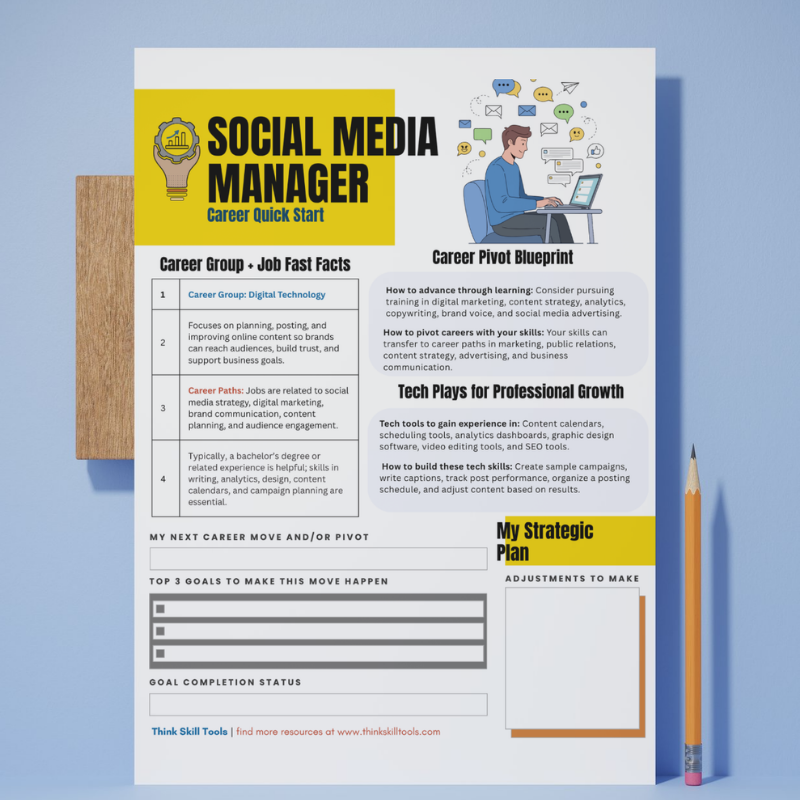
- Browse the Career Quick Start Guides and Planners to learn about specific occupations and compare possible directions before tailoring your resume.
- Try the Interview Prep Success Kit to organize your examples, practice common questions, and prepare to explain your career pivot during an interview.

Hello There! Nice to meet you 🙂
I am Dr. Danielle Reid. Career education and keeping learning fun really is my jam. No I am not a formally trained career coach. I am the product of a family that did some crazy-amazing career coaching to help me reach my dreams. Nowadays I find myself doing my own career coaching for my three kids, with a lot more knowledge, tools, and resources to share.
Additional Good Reads